


Samtavro Monastery — an ancient shrine of Georgia
Mtskheta is the ancient capital of Georgia and one of the country’s main spiritual centers. It is no coincidence that in old Georgian chronicles it was called “the Second Jerusalem.” It was here that the Christian history of Georgia began, and the city’s holy places have attracted pilgrims from all over the world for many centuries.
On the site where Saint Nino, Equal-to-the-Apostles and Enlightener of Georgia, preached, the majestic Samtavro Church rises today. It is now home to the stavropegial convent of Saint Nino, one of the most venerated Orthodox monasteries in the country.
The monastery preserves many great holy relics. Among them are the famous blackberry bush of Saint Nino (Makvlovani), near which the saint performed her prayerful labors; a particle of the Life-Giving Pillar of Svetitskhoveli; the wonderworking icons of the Mother of God “Iveron” and of Saint Nino Equal-to-the-Apostles; and the holy relics of Venerable Gabriel of Samtavro (Urgebadze). Every year thousands of pilgrims come here to venerate the shrines and receive spiritual consolation.
History of the monastery
After the repose of Saint Nino in Bodbe, King Mirian built a small church near the blackberry bush where she had preached the Christian faith. Today this place is known as the chapel called the “Small Church of Saint Nino.”
It is believed that the first church on the territory of Samtavro was built as early as the 4th century by order of King Mirian III. Over its many centuries of history, the church was repeatedly destroyed, but each time it was restored.
In the first half of the 11th century, during the reign of King George I, with the blessing of Catholicos-Patriarch Melchizedek I, the church was significantly enlarged. The southern gates were built and decorated with a unique ornament that has no parallel in Georgian architecture, while the interior of the church acquired a special splendor.
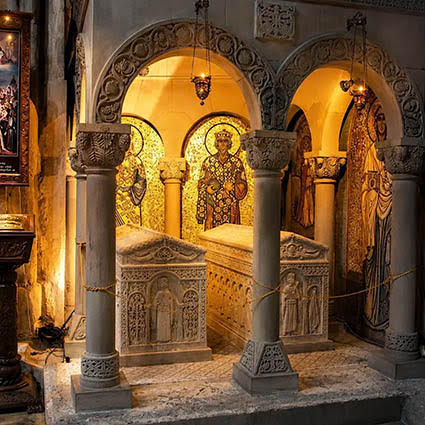
The Samtavro Transfiguration Church of the cross-in-square type, the small church of Saint Nino, the bell tower of the 15th–17th centuries, the fortress tower of the 18th century, the ancient iconostasis of the 15th century, and frescoes of the 17th century have survived to the present day.
In the southern part of the complex is the Church of the Archangel Michael. In the northern wing there are two side chapels: the eastern one is consecrated in honor of Saint John the Baptist, and the western one in the name of Saint John Chrysostom. Beside the main altar are the chapels of the holy royal saints Mirian and Nana.
Venerable Gabriel of Samtavro
A special place in the modern history of the monastery belongs to Venerable Gabriel of Samtavro (Urgebadze), one of the most venerated saints of our time.
The elder spent the final years of his earthly life at Samtavro, where for ten years he served as the monastery’s spiritual father. After his repose, he became the heavenly patron of the monastery. Today his holy relics are one of the monastery’s main shrines and a place of constant pilgrimage for the faithful.
The life of His Holiness and Beatitude Ilia II, Catholicos-Patriarch of All Georgia, is also closely connected with Samtavro. His godmother was the abbess of the monastery, and therefore the future Primate of the Georgian Church often visited this holy monastery from childhood, preserving a special love and reverence for it.
Monastic life today
At present, about seventy sisters labor in the monastery. Among them are novices, rassophores, and nuns. The long-standing abbess of the monastery is Abbess Ketevan (Kopaliani), who has made an enormous contribution to the revival of the monastery after the difficult years of godlessness.
The sisters’ life is organized according to the Athonite rule of the Iveron Monastery. Each day begins deep in the night. At 3:20 they rise, followed by the cell prayer rule. At four o’clock in the morning, the Midnight Office begins and continues until dawn. After a brief rest, the Divine Liturgy is celebrated.
Unceasing prayer has been offered at Samtavro for more than sixteen centuries, since the time of Saint Nino. From the 5th century, there was an episcopal see and a men’s monastery here, while the women’s monastery was founded in 1820.
Revival of the monastery
Abbess Nina Amilakhvari played a special role in the restoration of monastic life. Having accepted monasticism in 1810, she dedicated more than half a century of her life to Samtavro. Mother Nina traveled extensively throughout Georgia and Russia, collecting funds for the restoration of the monastery. For her labors she was awarded a high church honor.
During the years of Soviet rule, the monastery was closed. The sisters were left with only one room, and a labor artel was placed on the monastery grounds. Later a hospital was located here, and then part of the buildings was given to the Mtskheta Theological Seminary named after the Holy Apostle Andrew the First-Called.
Only at the end of the 20th century did the monastery begin gradually to return to a full spiritual life.
Abbess Ketevan — the spiritual mother of Samtavro
Many believers call Abbess Ketevan (Kopaliani) the spiritual mother of modern Georgia. Under her guidance, many abbesses of women’s monasteries in the country have grown and been formed.
For many years she has carried out her ministry with rare humility, patience, and love for people. As a spiritual daughter of His Holiness Patriarch Ilia II, Mother Ketevan devoted her entire life to serving the Church and monasticism.
Venerable Gabriel of Samtavro gave her spiritual support and guidance. Before she received monastic tonsure, the mantle was placed on her by the well-known elder Archimandrite Vitaly (Sidorenko), who blessed her with the icon of the Most Holy Theotokos “Abbess.”
Abbess Ketevan is also known as the author of spiritual poems. Many hymns written to her texts are performed during important church and national celebrations.
Her main characteristic, however, remains love for God, the Church, her people, and every person. It is precisely this love that has become the foundation of the spiritual atmosphere of Samtavro, a monastery that for many centuries has remained one of the brightest and most grace-filled places of Orthodox Georgia.